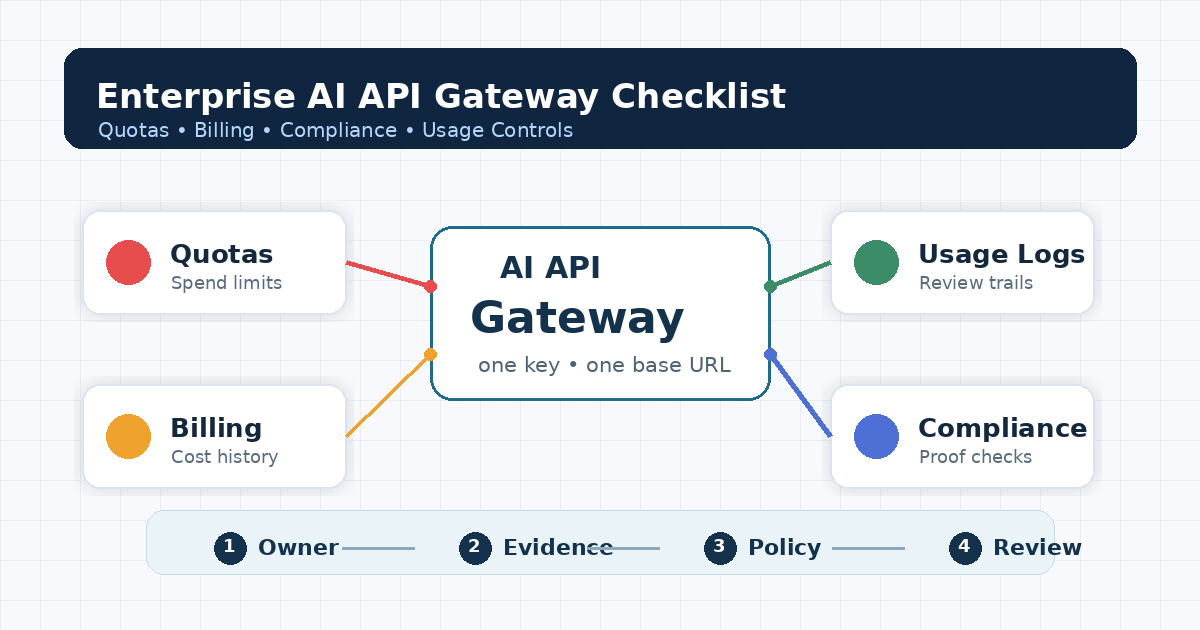
An enterprise AI API gateway is not ready for procurement just because it can route prompts to several models. At review time, the buyer needs to see who owns access, how spend is limited, how usage is reviewed, how billing is reconciled, and which compliance documents can be verified before production traffic moves through the gateway.
This checklist is written for engineering managers, platform teams, finance operators, and security reviewers who are comparing AI infrastructure. Use it to evaluate a gateway before signing off on quota controls, billing workflows, compliance evidence, and usage monitoring.
Flatkey positions its gateway around one API key, one OpenAI-compatible base URL, clear pricing, unified billing, and one dashboard for keys, usage, and routing. That is a strong procurement starting point, but enterprise review should still turn every claim into a source, owner, and acceptance test.
The search questions behind this review are practical: how to set AI API quota control, what an AI API billing dashboard should prove, which AI API usage monitoring fields matter, how AI API cost tracking connects to a budget owner, and how to secure AI model endpoints with API gateway controls before wider rollout.
Enterprise AI API Gateway Procurement Checklist
Start with the table below. The goal is not to collect every possible feature. The goal is to make sure the enterprise AI API gateway has enough control surface for the teams that will be accountable after launch.
| Review Area | What To Verify | Evidence To Collect | Owner |
|---|---|---|---|
| Access model | Which apps, teams, users, and environments can call the gateway. | Key inventory, base URL, model access policy, rotation process. | Engineering / platform |
| Quota controls | Whether limits can be set by team, key, model, budget, or environment. | Dashboard screenshots, quota policy, test request that hits a limit. | Engineering / finance |
| Billing visibility | How token, image, video, cache, and balance usage become invoice-ready records. | Pricing page, usage export, recharge or payment history, reconciliation owner. | Finance / ops |
| Usage monitoring | Which requests, costs, errors, and routing decisions are visible after launch. | Usage logs, cost dashboard, retention/export policy, incident review workflow. | Engineering / support |
| Compliance proof | Whether SOC 2, ISO 27001, GDPR, DPA, and legal-entity details match the review. | Certificate links, scope, validity dates, DPA, privacy policy, reviewer notes. | Security / legal |
| Operational ownership | Who handles failed upstreams, cost spikes, key leaks, provider changes, and offboarding. | Runbook, alert thresholds, fallback plan, rollback path, escalation contacts. | Platform / security |
1. Access Control: One Key Is Useful Only If Ownership Is Clear
The easiest gateway pitch is simple: one key, one base URL, many models. That reduces provider-account sprawl, but procurement reviewers should ask a more specific question: who owns the key after the first integration succeeds?
For an enterprise AI API gateway, access review should cover development, staging, and production separately. A prototype key used by one developer should not become a permanent production credential. Confirm who can create keys, where keys are stored, how rotation is handled, and whether inactive keys are reviewed on a schedule.
Flatkey's public copy says teams can use one API key and point OpenAI-compatible clients to https://router.flatkey.ai/v1. That is useful for migration, especially if existing SDKs can stay in place. The procurement version of that claim should add policy: production keys belong to a service owner, key rotation has a cadence, and usage is reviewable by the finance or operations owner that pays the bill.
2. Quota Controls: Decide What You Are Limiting Before You Buy
Quota controls are often discussed as a cost feature, but they are also a safety feature. A runaway job, prompt loop, unexpected model swap, or leaked key can turn into a billing problem fast. Your enterprise AI API gateway should make the blast radius small enough that teams can keep moving without opening a finance incident every time usage spikes.
Flatkey's public bundle includes the claim that teams can bill by actual usage, set quota limits, and keep team consumption clear at a glance. During review, turn that into a concrete acceptance test:
- Create or identify a non-production key.
- Set a low test quota or budget threshold.
- Send requests until the limit is reached.
- Confirm the error behavior, dashboard state, and billing record.
- Document who can raise the limit and who approves production exceptions.
Also check the dimension of each limit. A useful enterprise policy may need different limits for a sandbox, a batch workflow, a customer-facing feature, and a model-evaluation notebook. If the gateway only offers one account-wide cap, finance gets visibility but engineering may still lack control. If it supports more granular limits, record where those limits live and how reviewers can audit them.
3. Billing Visibility: Connect Usage To A Budget Owner
AI API billing is harder to approve when model vendors use different units, token accounting, cache behavior, image pricing, or video duration logic. A good enterprise AI API gateway should reduce that complexity enough for a finance reviewer to answer three questions: what was used, which team caused it, and which budget pays for it?
Flatkey's public pricing API snapshot collected on June 11, 2026 returned success: true, 656 model rows, 23 vendors, and supported endpoint paths for chat completions, responses, messages, image generation, video generation, and Gemini-style generation. Treat those details as publish-day evidence, not permanent copy. Before production launch, review the live model pricing page and the current rendered units for the exact models your team will use.
The billing checklist should include:
- Pricing source: where the current model price is displayed and who approves model changes.
- Usage source: where input, output, cache-hit, image, or video usage appears after a request.
- Recharge or payment history: where balance changes and payment records are reviewed.
- Cost owner: which team receives the monthly chargeback or budget note.
- Exception path: how temporary overages, incident traffic, and evaluation spikes are approved.
For more detailed pricing workflows, use Flatkey's AI model pricing comparison guide as an internal reference during evaluation.
4. Usage Monitoring: Logs Need To Be Useful After The Incident
Usage monitoring is where an enterprise AI API gateway becomes operational infrastructure instead of a thin proxy. A dashboard that shows only aggregate spend may be enough for a small prototype, but enterprise teams need enough detail to investigate failed calls, unexpected cost, model changes, and customer-impacting behavior.
At minimum, ask whether the gateway can help reviewers answer these questions:
- Which key, team, environment, or workflow generated the request?
- Which model or endpoint was called?
- How many billable units were recorded?
- Was the request routed, retried, failed over, or rejected?
- Which error code, latency, and cost were attached to the event?
- How long are logs retained, and can they be exported for audit or incident review?
Flatkey public copy references one dashboard for keys, usage, billing, and routing, plus usage and billing visibility. During procurement, keep the wording precise: public copy proves what the vendor claims, while the review should verify retention, exportability, and access permissions in the actual dashboard.
5. Compliance Evidence: Verify Scope, Entity, And Dates
Compliance claims deserve stricter wording than product features. Flatkey's public footer links a GDPR-powered-by-Vanta badge, a CAI SOC 2 certification badge, and a CAI ISO 27001:2022 certification badge. The linked certificate lookup pages returned active rows on June 11, 2026 for VOC AI Inc.; the SOC 2 Type II certificate listed validity from July 15, 2025 to July 14, 2026, and the ISO 27001:2022 certificate listed validity from May 1, 2024 to April 30, 2027.
That is enough to include the evidence in a procurement checklist, but not enough to skip review. A security or legal reviewer should confirm the legal entity relationship, report scope, covered systems, data processing terms, and whether the certificate scope matches the use of Flatkey as an enterprise AI API gateway.
Use this compliance review list:
- Legal entity: confirm the entity on the certificate and contract is the entity your organization is onboarding.
- Scope: confirm the report covers the services that process API traffic, usage logs, billing data, and dashboard access.
- Validity: record certificate dates and set a renewal check before expiration.
- Privacy: review the privacy policy, DPA, GDPR basis, subprocessor list, and data retention practices.
- Evidence storage: keep certificate links, screenshots, approval notes, and reviewer sign-off in the procurement record.
6. Routing And Reliability: Ask What Happens When An Upstream Fails
Many teams start with an AI gateway because they want fewer SDK changes and easier provider switching. That matters, but enterprise reviewers should ask how the routing layer behaves under failure. Flatkey's public copy says it can intelligently route multiple upstream accounts with automatic switching and load balancing to avoid frequent errors. For procurement, convert that into testable questions.
Ask which failures trigger a retry, which failures trigger upstream switching, and which failures are returned directly to the application. Check whether load balancing is account-based, provider-based, group-based, or another policy. Confirm how the dashboard exposes upstream incidents, route changes, and repeated failures. Your enterprise AI API gateway should make the routing decision visible enough that engineering can debug the incident and finance can understand the cost impact.
7. Migration Checklist: From Existing SDK To Controlled Gateway
If your current application already uses an OpenAI-compatible client, the migration path can be simple, but it should still be managed like an infrastructure change. Flatkey's public onboarding flow is: get one key, change the base URL, then monitor and optimize. The procurement-safe version is:
- Map models: list each current provider model, the target gateway model name, and the fallback choice.
- Change base URL in staging: point the client to
https://router.flatkey.ai/v1without changing production traffic. - Run smoke tests: confirm auth, streaming, tool use, multimodal input, and error handling for the endpoints you need.
- Set quotas: add non-production limits before expanding to production keys.
- Check billing records: compare usage logs to the expected request volume and model units.
- Document rollback: keep the direct-provider base URL and key path ready until the gateway has passed incident review.
The OpenAI-compatible API migration guide covers the base URL side of this process. This enterprise AI API gateway checklist covers the approval gates around it.
8. Procurement Questions To Ask Before Approval
Use these questions as the final review agenda. They are intentionally concrete so each answer can be assigned to an owner.
| Question | Why It Matters | Acceptable Evidence |
|---|---|---|
| Can we separate production, staging, and evaluation keys? | Limits blast radius and makes cost attribution cleaner. | Key list, owner list, rotation policy. |
| Can quotas stop runaway use before a budget incident? | Protects finance and reduces emergency approvals. | Quota test, rejected request, dashboard state. |
| Can finance reconcile usage to model pricing? | Prevents monthly spend disputes. | Pricing page, usage record, recharge or invoice history. |
| Can engineering debug a failed or expensive request? | Turns the gateway into operational infrastructure. | Usage log, error details, routing/fallback record. |
| Can security verify compliance claims independently? | Prevents vague badge-based approval. | Certificate links, scope, dates, DPA, privacy review. |
| Can we leave or rollback without losing visibility? | Protects engineering leverage and incident response. | Export plan, direct-provider fallback, key retirement plan. |
How Flatkey Fits This Review
Flatkey is built for teams that want one API key, one OpenAI-compatible base URL, clear pricing, unified billing, and one dashboard for model access, keys, usage, and routing. Its public proof points match the major review areas in this checklist: quota limits, pay-as-you-go billing, usage visibility, routing, load balancing, and compliance links.
The practical next step is to test those controls against your own procurement requirements. Start with the pricing page, open the dashboard, create a non-production key, set a test quota, make a staging request, and confirm that usage and cost records are visible to the right owner.
When the technical and finance checks pass, collect the compliance links and have security confirm the legal entity, scope, report dates, and data-processing language. That turns an enterprise AI API gateway evaluation from a feature demo into a reviewable infrastructure decision.
FAQ
What is an enterprise AI API gateway?
An enterprise AI API gateway is a managed layer between applications and AI model providers. It should help teams centralize keys, route requests, monitor usage, apply quota controls, review billing, and collect compliance evidence before production AI traffic scales.
Why do quota controls matter for AI API infrastructure?
Quota controls limit the financial and operational impact of runaway jobs, leaked keys, unexpected model usage, and evaluation spikes. They are especially important when multiple teams or workflows share the same AI provider budget.
What billing evidence should procurement request?
Procurement should request the current pricing source, a sample usage record, recharge or invoice history, model-unit definitions, budget owner mapping, and a process for approving temporary overages.
How should compliance badges be reviewed?
Treat badges as pointers to evidence, not as final approval. Reviewers should open the linked certificate or trust page, confirm legal entity and scope, record validity dates, and compare the evidence with the data-processing role of the gateway.
When is Flatkey a good fit for enterprise AI API gateway evaluation?
Flatkey is a fit when a team wants one API key, one compatible base URL, unified pricing and billing visibility, quota controls, usage logs, and routing across multiple model providers. The final decision should still depend on a dashboard test and procurement evidence review.
Final Review Step
Before approving any enterprise AI API gateway, assign an owner to every line of the checklist. Engineering should verify keys, routing, quotas, logs, and rollback. Finance should verify pricing, balance, usage records, and budget owners. Security and legal should verify compliance evidence, contract scope, and data handling.
To run the Flatkey version of this review, get a key, test the base URL in staging, and collect the quota, billing, usage, and compliance evidence your procurement team needs.