Claude API proxy searches usually start with a narrow problem: a developer wants Claude access behind a different base URL, a shared key, or a gateway that works with Claude Code, CC Switch, or another Anthropic-compatible tool. That is a reasonable need. If your whole stack is Claude-only, a provider-specific proxy can be the simplest answer.
The tradeoff appears when the same team also needs GPT, Gemini, DeepSeek, Qwen, image models, video models, usage logs, quota limits, billing review, and model switching. At that point, a Claude-only proxy may solve the immediate connection problem while leaving the operating model fragmented.
This comparison explains when a Claude API proxy is enough, when a multi-model router is the better control layer, and what to verify before routing Claude-related workflows through any gateway. Flatkey is not affiliated with Anthropic; Claude and Anthropic are referenced only to explain compatibility, protocol, and routing decisions.
Claude API Proxy Versus Multi-Model Router
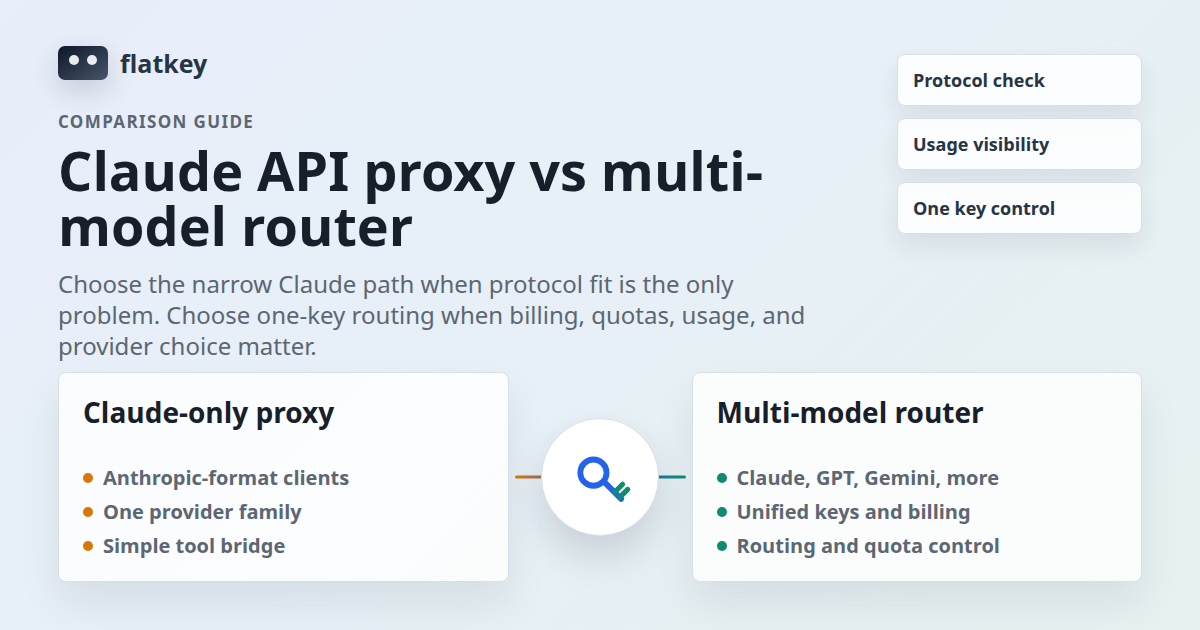
A Claude API proxy is usually built around one provider family. It may expose Anthropic Messages endpoints, forward Claude-specific headers, hold a shared Anthropic key, or adapt Claude traffic for a local tool. A multi-model router has a broader goal: keep access, keys, routing, usage, and billing in one layer across multiple model providers.
| Decision Area | Claude-Specific Proxy | Multi-Model Router |
|---|---|---|
| Best fit | One Claude workflow, one Anthropic-compatible client, limited team scope. | Several providers, several tools, shared billing, model switching, and team controls. |
| Provider scope | Usually Claude or Anthropic-format traffic. | Claude plus other providers such as GPT, Gemini, DeepSeek, Qwen, image, or video models. |
| Protocol focus | Often Anthropic Messages, Bedrock, Vertex, or a Claude-focused adapter. | Often OpenAI-compatible routing, with provider families exposed behind one key. |
| Key ownership | May still require separate provider accounts and key rotation practices. | Centralizes application keys and reduces separate provider-account work. |
| Billing and quotas | Useful for a Claude budget, but may not unify non-Claude spend. | Designed for cross-provider usage visibility, quota limits, and billing review. |
| Migration surface | Good when the client expects Anthropic-format endpoints. | Good when clients can point to one OpenAI-compatible base URL. |
| Failure handling | Can retry or redirect Claude paths if implemented. | Can support broader routing choices across approved model/provider paths. |
The practical question is not whether a Claude API proxy is "good" or "bad." The question is whether Claude is the whole operating surface or just one model family in a larger AI stack.
Protocol Details Matter Before You Switch Base URLs
Claude-related tooling is not one uniform protocol. Anthropic's Messages API uses POST /v1/messages and documented request headers such as anthropic-version. Claude Code's official LLM gateway guidance says a gateway must expose at least one supported API format, including Anthropic Messages endpoints such as /v1/messages and /v1/messages/count_tokens, and must forward relevant Anthropic headers.
That matters for any Claude API proxy evaluation. If a tool expects Anthropic Messages, an OpenAI-compatible router alone may not be enough unless that tool can run through an OpenAI-compatible mode or the router also exposes the needed Anthropic-format endpoints.
Claude Code's gateway docs also describe ANTHROPIC_BASE_URL for pointing Claude Code at a gateway, ANTHROPIC_AUTH_TOKEN for bearer-token authentication, and optional gateway model discovery through /v1/models when the gateway supports Anthropic Messages. Use those as your protocol checklist before assuming any Claude Code proxy setup will work.
# Template only: verify your gateway supports the API format your Claude tool expects.
ANTHROPIC_BASE_URL=https://your-gateway.example
ANTHROPIC_AUTH_TOKEN=your-gateway-token
CLAUDE_CODE_ENABLE_GATEWAY_MODEL_DISCOVERY=1
Anthropic also documents an OpenAI SDK compatibility layer for testing Claude through official OpenAI SDKs, but the same page positions that layer as a test-and-compare path rather than the best long-term production route for most use cases. If your search is "Claude Code proxy OpenAI API," start by separating tool protocol from provider choice.
When A Claude API Proxy Is Enough
A Claude API proxy is often enough when the workflow is narrow, stable, and intentionally Claude-specific. In that case, adding a broader router can create unnecessary decisions.
- One primary provider: your application, CLI, or internal tool is built around Claude and does not need GPT, Gemini, DeepSeek, Qwen, image, or video models.
- Anthropic-format client: the client expects Anthropic Messages behavior, Claude-specific headers, or Claude Code gateway semantics.
- Simple ownership: one engineer or team owns the provider account, key rotation, spend review, and incident response.
- No cross-provider fallback: the workflow should fail closed or wait rather than switch model families.
- Limited reporting needs: finance only needs Claude spend, not a unified view across multiple AI providers.
For example, a solo developer using one Claude Code workflow may prefer a small proxy that satisfies Anthropic Messages requirements and forwards the right headers. That is a clean Claude API proxy use case.
When One Key Beats A Provider-Specific Proxy
A multi-model router becomes more useful when the work stops being Claude-only. Flatkey's public site says teams can access Claude, GPT, Gemini, DeepSeek, Qwen, Seedance 2.0, GPT Image, and more with one API key, without managing separate provider accounts, with clear pricing, unified billing, and one dashboard for keys, usage, and routing. It also shows an OpenAI-compatible base URL at https://router.flatkey.ai/v1.
That is where a Claude API proxy starts to feel too narrow. The team may still want Claude, but it also wants one place to answer operational questions:
- Which app, team, or key generated this spend?
- Which model family handled each workflow?
- Can we set quotas before experiments consume production budget?
- Can we compare Claude with GPT, Gemini, DeepSeek, or Qwen without creating a new credential flow each time?
- Can finance review usage and billing from the same dashboard as engineering?
- Can model changes happen through routing policy instead of SDK rewrites?
If those questions are part of the buying process, a multi-model router gives the organization a better control plane than a provider-specific proxy.
The Claude Code And CC Switch Check
Claude Code and adjacent tools make the comparison more nuanced. Claude Code's official gateway docs are explicit about API formats, header forwarding, authentication, and model discovery behavior. That means a Claude API proxy can be the right component when the tool requires Anthropic-format behavior.
Flatkey's public proof is strongest for the other side of the workflow: one key, an OpenAI-compatible base URL, unified billing, usage visibility, routing, and access to several model families. Its public navigation also names CC Switch as a supported tool context. Before connecting any Claude-focused tool, test the exact mode the tool uses: Anthropic Messages, OpenAI-compatible chat completions, OpenAI Responses, or another adapter path.
| Question To Ask | Why It Matters |
|---|---|
| Does the tool require Anthropic Messages endpoints? | If yes, verify /v1/messages, token counting, and header forwarding before production. |
| Can the tool use an OpenAI-compatible base URL? | If yes, a router such as Flatkey can reduce provider-specific setup across non-Claude models too. |
| Who owns the key? | Shared tool keys need revocation, quotas, and usage visibility, not just a working URL. |
| Does the team need non-Claude models? | If yes, a Claude-only proxy may become a temporary bridge rather than the long-term access layer. |
| What happens when a model is unavailable or too expensive? | The answer should be a visible routing policy, not a hidden fallback that changes behavior unexpectedly. |
This check also prevents overpromising. Do not assume that a Claude API proxy, an OpenAI-compatible API, and a Claude Code gateway are interchangeable. They overlap, but the protocol boundary decides whether the setup is safe.
Billing, Usage Logs, And Quotas Are The Real Difference
Provider-specific proxies are often evaluated on connection success: did the request reach Claude, and did the response come back? Commercial buyers care about the next layer: can the organization see spend, limit usage, allocate cost, and change routes without losing control?
Flatkey's public copy emphasizes pay-as-you-go usage, quota limits, team consumption visibility, usage and billing visibility, and a dashboard for keys and routing. Its pricing API snapshot saved on June 11, 2026 returned Claude-related rows and multiple supported endpoint families, including OpenAI, Anthropic, Gemini, image-generation, OpenAI Responses, and OpenAI video. Treat those counts as dated catalog evidence, not as a permanent model-count promise.
For a buyer, the durable comparison is this: a Claude API proxy solves provider-specific access, while a multi-model router helps govern model access as an operating system for the team.
Migration Path: Proxy First Or Router First?
Use this sequence to choose the rollout path.
- Inventory clients: list Claude Code, CC Switch, backend services, notebooks, and automation jobs that call model APIs.
- Mark the required protocol: Anthropic Messages, OpenAI-compatible chat completions, OpenAI Responses, Gemini, image, video, or provider-native endpoints.
- Separate Claude-only workloads: keep Anthropic-format tools on a compatible Claude API proxy if they need Claude-specific semantics.
- Route OpenAI-compatible workloads through one key: point compatible clients at
https://router.flatkey.ai/v1and verify model IDs, streaming, tools, and logging in staging. - Add quota and billing checks: confirm the dashboard records team usage, token spend, errors, and route behavior before production traffic moves.
- Promote model switching deliberately: do not hide provider changes behind a fallback unless product, support, and finance accept the behavior.
If you are changing base URLs in an existing SDK, use the OpenAI-compatible API migration guide. If you are comparing self-hosted proxy ownership against a managed gateway, the LiteLLM alternatives guide covers that operating-model decision.
FAQ
What is a Claude API proxy?
A Claude API proxy is a gateway or adapter that sits between a client and Claude-related model access. It may centralize keys, expose Anthropic-compatible endpoints, forward Claude-specific headers, or adapt a tool to a different base URL.
Is a Claude API proxy the same as a multi-model router?
No. A Claude API proxy is usually provider-specific. A multi-model router is broader: it centralizes access, keys, usage, billing, quotas, and routing across Claude and non-Claude model providers.
Can Claude Code use a gateway?
Yes, Claude Code's official LLM gateway docs describe gateway configuration with variables such as ANTHROPIC_BASE_URL and ANTHROPIC_AUTH_TOKEN. The gateway still needs to expose a supported API format and forward required headers.
When should I choose a Claude-only proxy?
Choose a Claude-only proxy when the workflow is intentionally Claude-specific, the client expects Anthropic Messages behavior, and you do not need unified non-Claude billing, quotas, or model switching.
When should I choose Flatkey instead of a Claude API proxy?
Choose Flatkey when Claude is one of several models your team needs and you want one API key, one OpenAI-compatible base URL, centralized usage visibility, routing, quota controls, and billing across multiple providers.
Final Recommendation
Use a Claude API proxy when the job is simply to make a Claude-specific tool work with the protocol it expects. Use a multi-model router when the job is to operate Claude alongside GPT, Gemini, DeepSeek, Qwen, image models, video models, usage logs, quotas, and billing in one place.
For teams that have moved beyond one provider-specific proxy, Flatkey's value is the unified access layer: one key, one OpenAI-compatible base URL, and one dashboard for model access, routing, usage, and billing. Review current model availability on View Pricing, then test the exact workflow through setup before moving production traffic.