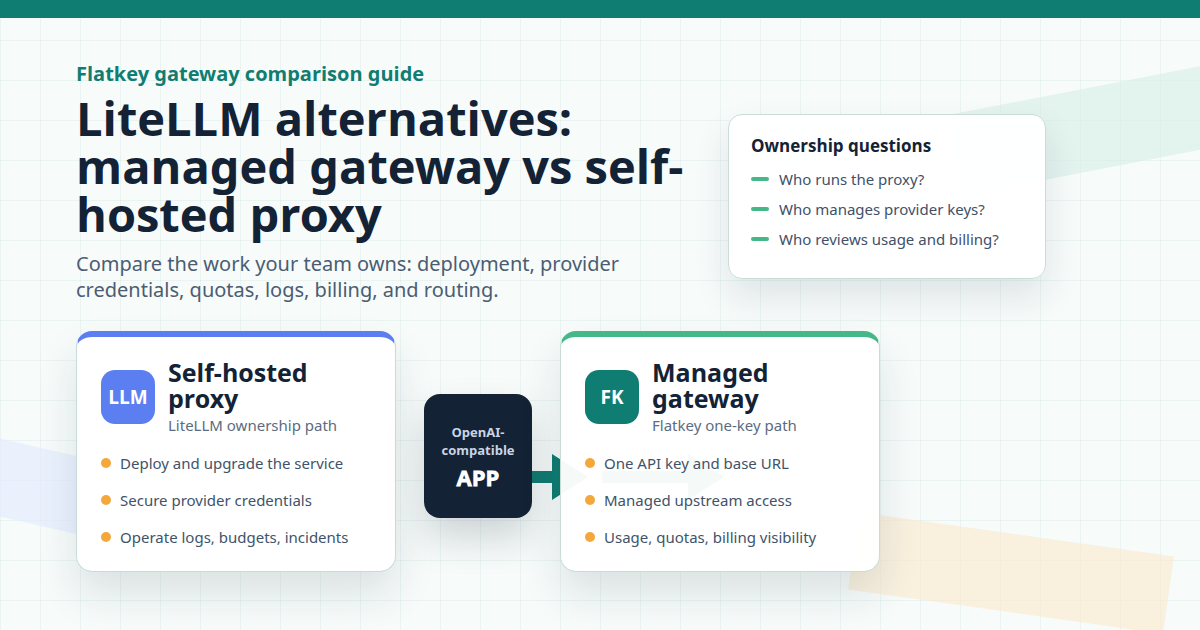
If you are comparing LiteLLM alternatives, the real question is not only "Which tool can proxy LLM calls?" It is "Which parts of the gateway do we want to own?"
LiteLLM is a strong choice when your team wants an open-source, self-hosted LLM proxy. Its docs position LiteLLM as a unified interface for 100+ LLMs using the OpenAI format, with a self-hosted proxy, virtual keys, cost tracking, an admin UI, routing, retries, fallbacks, and load balancing.
That is exactly why the LiteLLM alternatives decision matters. If you choose LiteLLM, your team gets control, but also owns the service around it: deployment, provider credentials, secrets, upgrades, uptime, logs, budgets, failure handling, and on-call response. If you choose a managed gateway like Flatkey, the goal is different: keep OpenAI-compatible migration, one key, managed upstream access, clear pricing, unified billing, quota controls, and dashboard visibility without running the proxy yourself.
This guide compares LiteLLM alternatives through ownership, not feature checklists. Use it to decide when LiteLLM is the right self-hosted proxy, when Flatkey is the better litellm alternative, and when direct provider accounts or other gateway patterns make more sense.
Quick Answer: The Best LiteLLM Alternative Depends On What You Want To Own
The best LiteLLM alternative is the one that matches your operational model.
| If Your Priority Is... | Start With | Why |
|---|---|---|
| Self-hosted LLM proxy control | LiteLLM | You own the proxy, routing policy, provider config, deployment, and integration surface. |
| Managed one-key access and billing visibility | Flatkey | You get a hosted gateway pattern with one API key, OpenAI-compatible base URL, unified billing, quota controls, and dashboard visibility. |
| Direct vendor relationship | Direct provider accounts | You work with OpenAI, Anthropic, Google, DeepSeek, or another provider directly, but own key sprawl and routing logic. |
| Cloud-platform-native gateway | Your app platform's gateway | Useful when your deployment platform already controls the AI workflow and observability stack. |
| Internal custom gateway build | A bespoke proxy | Useful only when your requirements justify building and maintaining gateway logic yourself. |
In short: choose LiteLLM when self-hosting is a requirement. Choose Flatkey when your team is searching for LiteLLM alternatives because it wants the gateway to reduce operations work instead of adding another service to run.
What LiteLLM Does Well
Any serious comparison of LiteLLM alternatives should start by acknowledging what LiteLLM is good at.
LiteLLM's official docs describe it as an open-source library that provides a unified interface to call many LLM providers using the OpenAI format. The docs also describe a self-hosted proxy server, sometimes framed as an LLM gateway, that can work with OpenAI-compatible clients.
For platform teams, those are meaningful capabilities:
- OpenAI-format calls across many providers.
- A proxy server that can sit between applications and model providers.
- Virtual keys for access control.
- Spend tracking across keys, users, and teams.
- Budgets and rate limits.
- Routing, load balancing, retries, fallbacks, timeouts, and cooldowns.
- Admin UI and operational controls.
- Production deployment guidance that includes runtime and infrastructure considerations.
Those facts make LiteLLM a credible answer for teams that explicitly want open-source gateway ownership. The right way to evaluate LiteLLM alternatives is not to dismiss that value. It is to ask whether your team wants to own the surrounding operations.
Why Teams Look For LiteLLM Alternatives
Teams usually search for LiteLLM alternatives after one of four moments.
First, the prototype worked, but the team does not want to operate the proxy in production. The proxy becomes another service with deployment, monitoring, secrets, incident response, and upgrade planning.
Second, provider access gets messy. Each upstream account brings credentials, billing rules, rate limits, model names, policy changes, and support questions. A self-hosted proxy can centralize calls, but the team still owns the upstream account management.
Third, finance and product teams need clearer cost controls. LiteLLM has spend tracking and budget features, but with self-hosting your team still owns configuration, data plumbing, reporting, and the operational workflow around those controls.
Fourth, application teams want OpenAI-compatible migration without becoming platform-infrastructure owners. They want to change a base URL and key, verify model IDs, watch usage, and move on.
Those are the cases where litellm proxy alternatives become a build-vs-buy decision.
Managed Gateway vs Self-Hosted Proxy: Ownership Matrix
Use this matrix before shortlisting LiteLLM alternatives.
| Decision Area | Self-Hosted LiteLLM Proxy | Managed Gateway Like Flatkey | What To Ask Internally |
|---|---|---|---|
| Deployment | Your team runs the proxy, workers, runtime, config, and release process. | The gateway is hosted for you. | Do we want another production service in our ownership map? |
| Provider credentials | Your team configures and protects upstream provider keys. | Managed upstream access is part of the product promise. | Do we want to manage separate provider accounts and secrets? |
| Client migration | OpenAI-format clients can point at your proxy endpoint. | OpenAI-compatible clients can point at https://router.flatkey.ai/v1. |
Can we keep SDK changes small either way? |
| Keys and access | LiteLLM supports virtual keys and related controls. | Flatkey public copy emphasizes one key and dashboard visibility for keys. | Who creates, rotates, and audits keys? |
| Budgets and quotas | LiteLLM supports budget and rate-limit controls, but you configure and operate them. | Flatkey public copy mentions quota limits and pay-as-you-go usage visibility. | Do we want to operate budget policy or consume it as a product feature? |
| Usage and spend logs | LiteLLM has spend tracking across keys, users, and teams. | Flatkey public copy mentions usage and billing visibility in one dashboard. | Who needs cost review, and where will they review it? |
| Routing and failover | LiteLLM supports routing, load balancing, fallbacks, retries, and cooldowns. | Flatkey public copy mentions automatic switching and load balancing. | Do we need custom routing policy or managed routing behavior? |
| Upgrades | Your team handles version upgrades and compatibility checks. | The managed provider owns platform updates. | Do we have capacity for gateway maintenance? |
| Incident response | Your team owns proxy incidents and upstream integration debugging. | The managed provider owns the hosted gateway layer. | Who is on call when model access fails? |
| Procurement | Open-source self-hosting may fit internal control requirements. | Managed service review may be simpler for teams that prefer vendor accountability. | Does policy require self-hosting, or does it prefer managed support? |
The table does not say one path is universally better. It shows why LiteLLM alternatives should be evaluated by ownership boundary.
When LiteLLM Is The Right Choice
LiteLLM is the right starting point when self-hosting is an advantage.
Choose LiteLLM when:
- Your platform team wants direct control over the gateway layer.
- You need to run the proxy inside your own infrastructure.
- You want to design custom routing, access, or policy logic.
- You have the engineering capacity to operate the service.
- You already have mature observability, secret management, release, and on-call processes.
- You accept responsibility for provider configuration and gateway upgrades.
This is the strongest case for litellm alternatives open source self-hosted searches: the team is not trying to avoid ownership. It wants ownership.
For those teams, a managed gateway may feel too abstract. They may prefer LiteLLM because it gives them the control surface they need. That is a valid answer.
When Flatkey Is The Better LiteLLM Alternative
Flatkey is the better litellm alternative when the team wants the gateway problem handled as a managed product.
Flatkey's public product copy supports a clear position: one API key, no need to manage separate provider accounts, clear pricing, unified billing, and one dashboard for keys, usage, and routing. It also publishes the OpenAI-compatible base URL https://router.flatkey.ai/v1 and mentions usage/billing visibility, quota limits, automatic switching, and load balancing.
That makes Flatkey a practical option for teams comparing LiteLLM alternatives because they want less infrastructure work.
Choose Flatkey when:
- You want one key for multi-model access.
- You want to avoid managing separate provider accounts.
- You want an OpenAI-compatible base URL migration path.
- You want billing and usage visibility in a hosted dashboard.
- You want quota controls without building the surrounding workflow yourself.
- You want managed routing across model families without running a proxy.
- Your application team should focus on product code, not gateway operations.
Flatkey is not a drop-in answer for every LiteLLM use case. If you need custom gateway plugins, self-hosted policy enforcement, or infrastructure-local control, LiteLLM may still be the right choice. But when the business goal is "do not make the model gateway another internal platform project," Flatkey is the alternative to LiteLLM to evaluate first.
Provider Credentials Are The Hidden Decision
Most LiteLLM alternatives pages compare model lists. That misses the harder issue: provider credentials.
When you self-host a proxy, your team still needs to decide how upstream provider keys are created, stored, rotated, audited, and mapped to internal usage. You also need to handle provider-specific account approvals, limits, and support paths.
LiteLLM can centralize access through a proxy, but your team owns the upstream setup. Flatkey's managed positioning is different: its public copy says users can call connected AI models without applying for each provider separately. That is a major operational distinction for product teams that do not want every model launch to become an account-management task.
When reviewing litellm proxy alternatives, ask this before anything else:
| Question | Why It Matters |
|---|---|
| Who owns provider accounts? | Determines procurement, support, billing, and failure ownership. |
| Who rotates provider secrets? | Affects security operations and incident response. |
| Who maps model IDs to application routes? | Affects deploy risk and model-change workflows. |
| Who reviews upstream rate limits? | Affects reliability under traffic growth. |
| Who explains spend to finance? | Affects cost accountability and product planning. |
If those answers point to an internal platform team, LiteLLM may fit. If those answers point to a product team that wants a managed surface, Flatkey fits the LiteLLM alternatives search better.
Billing, Quotas, And Logs: Do Not Compare Only Proxy Features
The most useful LiteLLM alternatives comparison is not "does it have budgets?" It is "who operates the budget workflow?"
LiteLLM's docs include spend tracking, virtual keys, budgets, and rate limits. That is valuable. But in self-hosted mode, the team still decides how those controls are configured, where reports land, how finance reviews them, how exceptions are approved, and how alerts become action.
Flatkey's public copy emphasizes pay-as-you-go billing, quota limits, usage and billing visibility, and one dashboard for keys and routing. That is useful when the desired workflow is not "build a cost-control system around the proxy," but "use a managed dashboard for cost and usage review."
When you compare LiteLLM alternatives, score each option on the operational workflow:
- Can engineers see request usage by key or route?
- Can product owners understand which model family drives cost?
- Can finance review billing without parsing proxy logs?
- Can teams set quotas before traffic grows?
- Can support diagnose whether an issue is app code, gateway routing, or upstream provider behavior?
The strongest litellm proxy alternatives will make those answers simple for the specific team doing the work.
Migration Test: How To Evaluate A LiteLLM Alternative
Do not migrate your entire model layer at once. Test LiteLLM alternatives with one real workflow.
- Pick one production-shaped workload, such as chat completions, coding-agent calls, embeddings, image generation, or batch automation.
- Record the current request path, model ID, token use, latency, failure rate, retry behavior, and cost per successful outcome.
- List the controls you actually use today: virtual keys, budgets, rate limits, routing rules, fallbacks, spend logs, or dashboard reports.
- Create a test key in the alternative gateway.
- Change only the API key, base URL, and model ID where possible.
- Replay a small traffic sample.
- Compare output quality, errors, logs, quota behavior, billing visibility, and rollback steps.
For Flatkey, the OpenAI-compatible client setup to validate is:
import os
from openai import OpenAI

client = OpenAI(
    api_key=os.environ["FLATKEY_API_KEY"],
    base_url="https://router.flatkey.ai/v1",
)

# Copy the exact model ID from your Flatkey console or pricing page.
This snippet intentionally stops at client setup. Before publishing runnable examples for a specific model, verify the model ID, endpoint type, request body, and expected response through the Flatkey console or model pricing page.
Decision Guide By Team Type
| Team Type | Best Starting Point | Reason |
|---|---|---|
| Platform team with strong infrastructure ownership | LiteLLM | The team can operate the proxy and wants control. |
| Backend team adding multi-model access quickly | Flatkey | One key, OpenAI-compatible migration, billing visibility, and managed routing reduce setup work. |
| AI product team without a dedicated platform group | Flatkey | The team likely wants access, quotas, logs, and billing visibility without owning proxy uptime. |
| Regulated team with internal hosting requirements | LiteLLM or internal gateway | Self-hosting may be required by policy. |
| Team with strict direct vendor contracts | Direct provider accounts | Official provider relationships may matter more than gateway simplicity. |
| Team experimenting before production | LiteLLM, Flatkey, or direct accounts | Run the same workload and compare operational fit before standardizing. |
This is why a single best LiteLLM alternative answer is usually incomplete. The better question is which team owns the gateway after launch.
Recommendation
If your team wants a self-hosted LLM proxy and has the operational muscle to run it, LiteLLM is a strong choice. Its official docs show a serious proxy surface: OpenAI-format calls, virtual keys, spend tracking, budgets, rate limits, routing, retries, fallbacks, load balancing, and production guidance.
If your team is searching for LiteLLM alternatives because it does not want to run the gateway, start with Flatkey. Flatkey's public product surface lines up with the managed path: one API key, OpenAI-compatible base URL, unified billing, dashboard visibility for keys, usage, and routing, quota limits, automatic switching, and load balancing.
The practical decision is not open source versus managed in the abstract. It is ownership. Use LiteLLM when you want to own the proxy. Use Flatkey when you want one managed key and a hosted control surface. Use direct provider accounts when contracts or native provider features are more important than gateway simplicity.
FAQ
What are the best LiteLLM alternatives?
The best LiteLLM alternatives depend on what you want to own. Flatkey is a managed litellm alternative for one-key routing, unified billing, quotas, usage visibility, and OpenAI-compatible migration. Direct provider accounts are better when official contracts matter most. A custom internal proxy only makes sense when your requirements justify building and operating gateway logic yourself.
Is Flatkey a LiteLLM alternative?
Yes. Flatkey is a managed LiteLLM alternative for teams that want multi-model access without running a self-hosted proxy. Flatkey public copy supports one API key, no separate provider accounts, unified billing, usage and routing visibility, quota limits, automatic switching, load balancing, and the OpenAI-compatible base URL https://router.flatkey.ai/v1.
Is LiteLLM still a good choice?
Yes. LiteLLM is a good choice when your team wants an open-source, self-hosted LLM proxy and has the capacity to run it. The point of comparing LiteLLM alternatives is not that LiteLLM is weak. It is that some teams want managed gateway ownership instead of proxy ownership.
What should I compare in litellm proxy alternatives?
When comparing litellm proxy alternatives, compare deployment ownership, provider credentials, key management, budget controls, usage logs, billing workflow, routing and fallback behavior, upgrades, incident response, and support. Do not compare only model count.
What is the best LiteLLM alternative for teams that do not want to self-host?
For teams that do not want to self-host, Flatkey is the best LiteLLM alternative to evaluate first because its public product surface is managed: one key, OpenAI-compatible base URL, unified billing, usage dashboard, quota limits, and routing visibility.
Are there open source LLM proxy alternatives to LiteLLM?
There are open-source and self-hosted gateway patterns beyond LiteLLM, but this article does not make unsourced claims about specific open-source competitors. If you are searching for open source LLM proxy alternatives to LiteLLM, compare project maturity, supported providers, routing controls, auth model, budget controls, observability hooks, and maintenance burden from each project's official docs.
Can I keep using the OpenAI SDK with LiteLLM alternatives?
Often, yes, but verify each gateway. LiteLLM's docs show OpenAI-format and OpenAI-client proxy usage. Flatkey publishes https://router.flatkey.ai/v1 as an OpenAI-compatible base URL. For any alternative to LiteLLM, test the exact endpoint, model ID, request body, streaming behavior, and error handling before migration.
Get a key or view pricing to compare the managed gateway path.